Beyond Drag-and-Drop: Why I Choose Custom Code for WordPress
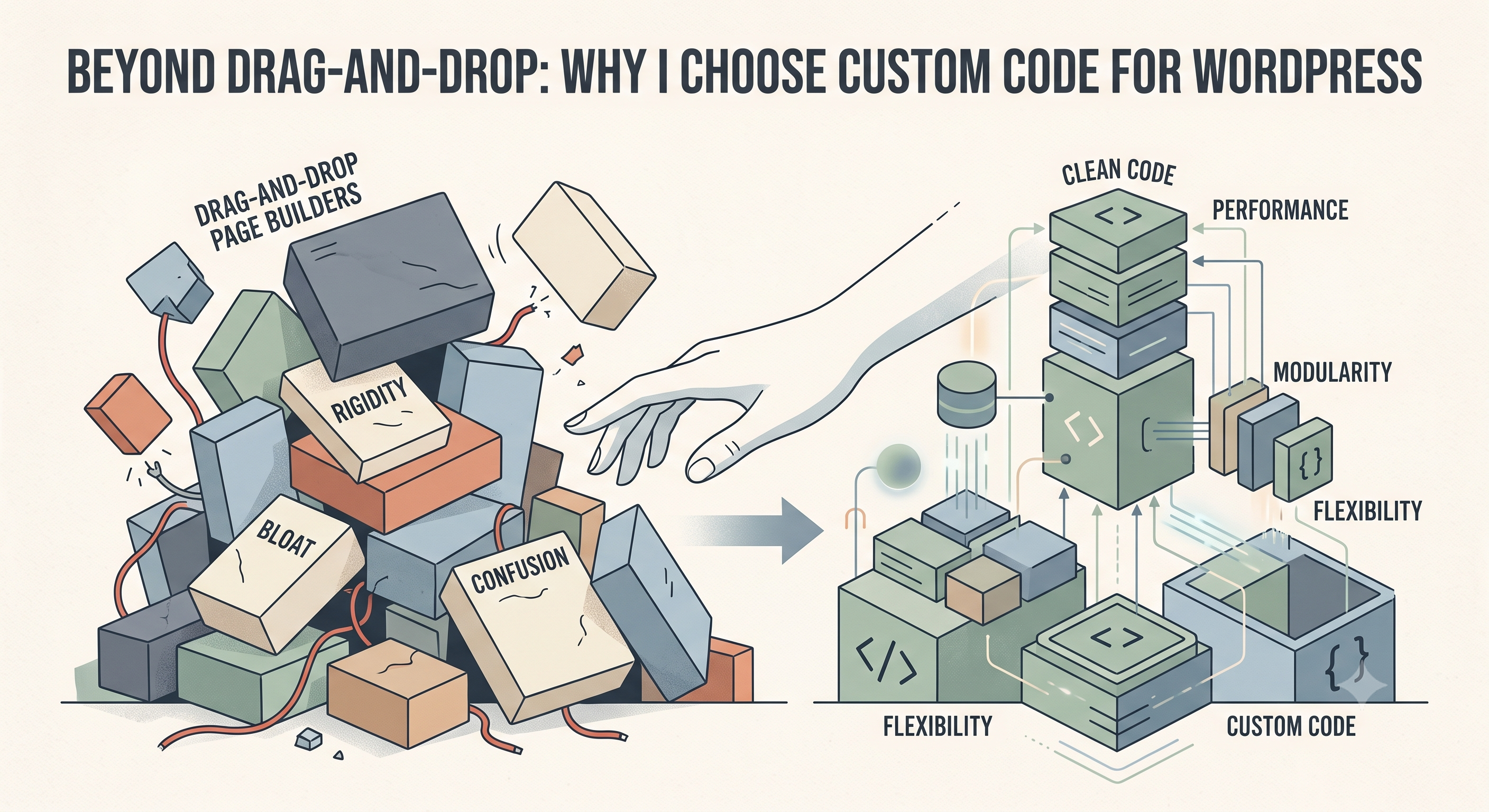
When diving into WordPress, the allure of page builders like Elementor or Divi is undeniable. They promise a website in hours, not weeks, with a visual interface that makes design feel like child’s play. I get it; I’ve even dipped my toes in those waters. But after years of building and maintaining sites for myself and clients, I’ve come to a firm, unwavering conclusion: for any serious project, custom-coded WordPress themes are unequivocally superior.
The most immediate and glaring issue with page builders is their impact on performance. While they offer dazzling visual interfaces, what they produce under the hood is often a spaghetti of unnecessary HTML, bloated CSS, and excessive JavaScript. Every wrapper div, every custom class, every inline style rule generated by a drag-and-drop action adds milliseconds to your page load time. We're talking hundreds of extra kilobytes, sometimes megabytes, of code that a lean, custom theme simply doesn't need. My clients care about speed – Google cares about speed, and your users certainly do – and a custom theme, built with only the necessary components, will always outpace a page builder in raw performance, delivering a snappier user experience and significantly better SEO. That translates directly to higher rankings and happier visitors.
Beyond raw speed, the true power of custom development lies in its unmatched modularity and scalability. Page builders, by their very nature, impose a specific architecture. You’re building within their sandbox, often struggling to achieve truly unique designs or implement complex, bespoke functionalities without clunky workarounds. Want to integrate a custom API or create a truly unique interactive component? With Elementor, you're often fighting the system, trying to shoehorn your vision into their predefined modules. With a custom theme, using powerful tools like Advanced Custom Fields (ACF) or crafting custom Gutenberg blocks with React, I can design and build precisely the content structures needed. This allows for truly reusable modules that perfectly fit the client's data and design requirements. This isn't just about aesthetics; it’s about creating a truly adaptable and future-proof platform. There's no vendor lock-in; the code is yours, clean and accessible, making future updates, redesigns, or even migrations significantly smoother and less prone to breaking changes.
Think of long-term maintenance and ownership. When a page builder has an update, or WordPress itself changes, you're often at the mercy of the builder's developers to ensure compatibility. Debugging issues within a builder's generated code can be a nightmare due to its complexity and abstraction layers. With a custom theme, I know every line of code. I control the dependencies, the styling, and the functionality. This allows for far more robust error handling, easier debugging, and a much clearer path for long-term support and feature additions. It’s an investment in a cleaner, more efficient codebase that pays dividends for years, ensuring the website remains performant and secure without constant battles against unnecessary bloat or rigid systems that dictate how your site must be built.
I understand the appeal of page builders for quick projects or for those just starting out. They lower the barrier to entry, which is fantastic for hobbyists. But for any serious business or individual looking for a website that truly performs, stands out with unique branding, and scales seamlessly with their ambitions, the effort invested in custom WordPress theme development is invaluable. It’s about building a solid, high-performance foundation, not just a pretty facade that adds unnecessary weight. It’s about owning your architecture, ensuring peak performance, and gaining the ultimate flexibility to evolve your online presence without compromise. If you're serious about your website, it's time to look beyond the drag-and-drop and embrace the power of custom code.