Building Modern WordPress: Why I Chose Sage Over Page Builder Bloat
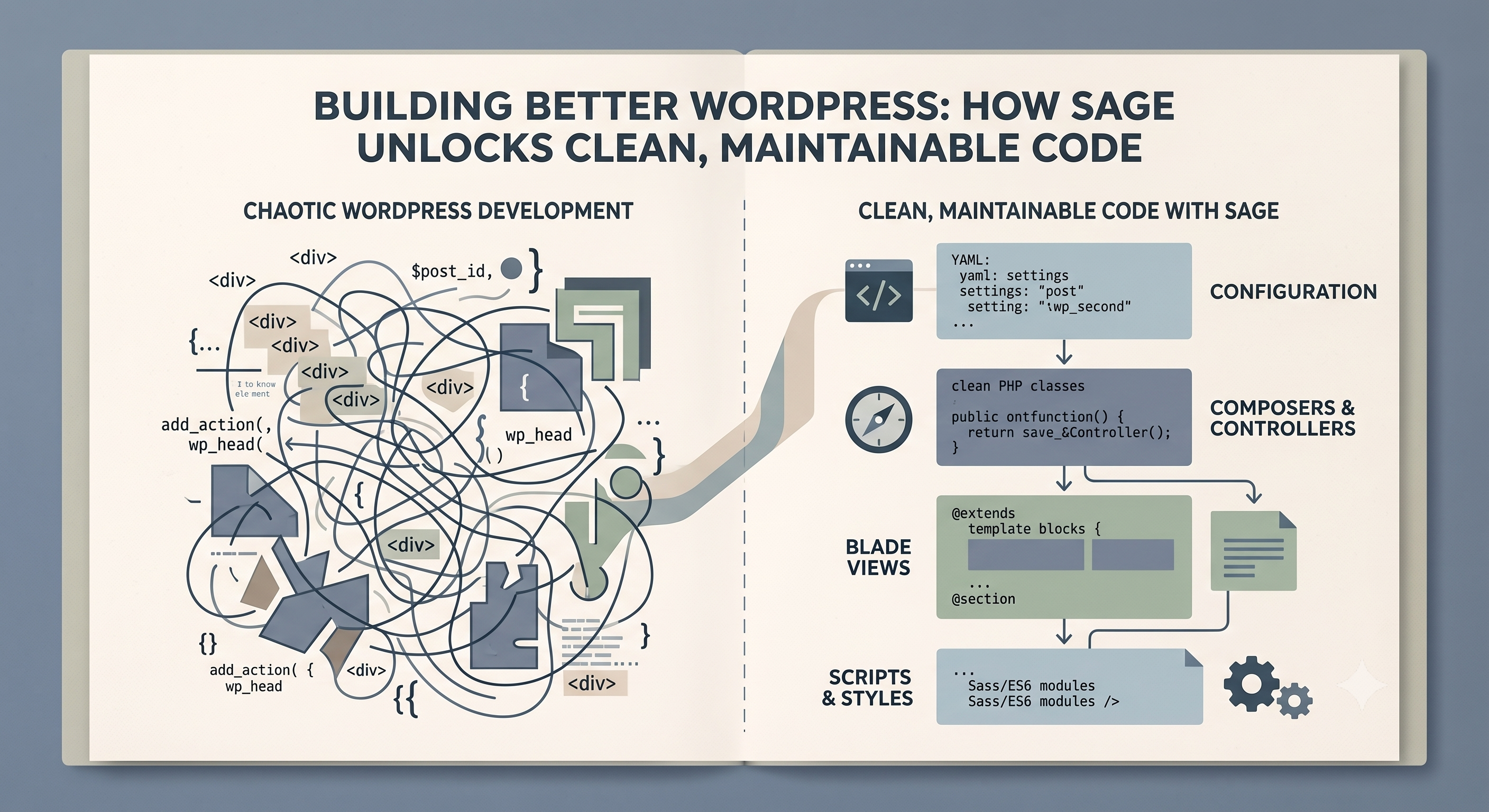
For years, the WordPress development landscape felt like a compromise. You could either build a completely custom theme, wading through the spaghetti of `functions.php` and template files often mixing HTML, PHP logic, and database queries, or you could lean on page builders like Divi or Elementor. The latter promised speed and visual editing, but for a developer, they quickly became a nightmare of unmaintainable database bloat, performance issues, and an inability to truly control the output. That’s why discovering Sage was a revelation; it finally offered a modern, organized, and truly developer-friendly way to build WordPress themes.
Sage isn't just another theme framework; it's a fundamental shift in how you approach WordPress development. It brings a clean, MVC-like architecture to the platform, leveraging best practices from the wider PHP ecosystem, particularly Laravel. This means your codebase becomes predictable, maintainable, and a joy to work with, a stark contrast to the often chaotic nature of traditional WordPress projects. The core idea is a strong separation of concerns, ensuring each part of your application has a singular, well-defined responsibility.
At the heart of Sage’s templating system is Blade, Laravel’s powerful yet simple templating engine. This is where the magic of "presentation-focused" templates truly shines. Your `.blade.php` files contain only the HTML markup and minimal, readable control structures – loops, conditionals, and component includes. You won’t find complex `WP_Query` calls or database interactions directly embedded in your templates. This discipline makes your front-end code incredibly clean, easy to read, and a breeze to collaborate on, as designers can work with largely static HTML structures without being intimidated by deep PHP logic.
So, how does data get to these pristine templates? That's where View Composers come in. These powerful classes act as intermediaries, cleanly routing the necessary data to your Blade views. Instead of fetching post meta, related posts, or author data directly within your `single.blade.php`, you encapsulate all that logic within a dedicated View Composer. This keeps your templates entirely focused on presentation, while your data preparation and fetching logic reside in well-structured PHP classes. It's an elegant solution that drastically improves testability and maintainability by centralizing data concerns.
Underpinning much of Sage's modern capabilities is Acorn, a lightweight Laravel-like framework integrated directly into WordPress. Acorn brings powerful features like a robust service container and modern dependency injection (DI) to your WordPress projects. This means you can easily manage complex dependencies, inject services into your classes, and build highly modular, testable code. Gone are the days of relying heavily on global variables and functions; with Acorn, you gain the benefits of a truly programmatic and organized codebase, making scaling and collaboration infinitely easier.
Now, let's talk about the elephant in the room: page builders. Divi and Elementor are marketed as solutions, but for developers, they often create more problems than they solve. Their reliance on complex shortcodes, JSON data, and custom markup stored directly within the database's `post_content` field leads to an unmaintainable mess. Debugging becomes a nightmare, performance suffers due to excessive inline CSS/JS and convoluted database queries, and worst of all, your "design" isn't version-controlled in a meaningful way. You can't `git diff` a page builder layout change, and migrating content often leads to breaking layouts if plugins or themes change.
Sage completely sidesteps these issues. Every piece of your theme — from layouts and templates to data fetching logic and custom functionality — lives in version-controlled files. This provides clarity, predictability, and stability. You're building a truly custom, optimized, and developer-centric WordPress theme, free from the limitations and bloat of visual builders. For anyone serious about crafting high-performance, maintainable, and modern WordPress websites, Sage isn't just an option; it's the clear choice.