Ditch the Bloat: Why Vanilla WordPress, Custom Blocks, and `$wpdb` are Your Only Path to Enterprise-Grade Performance
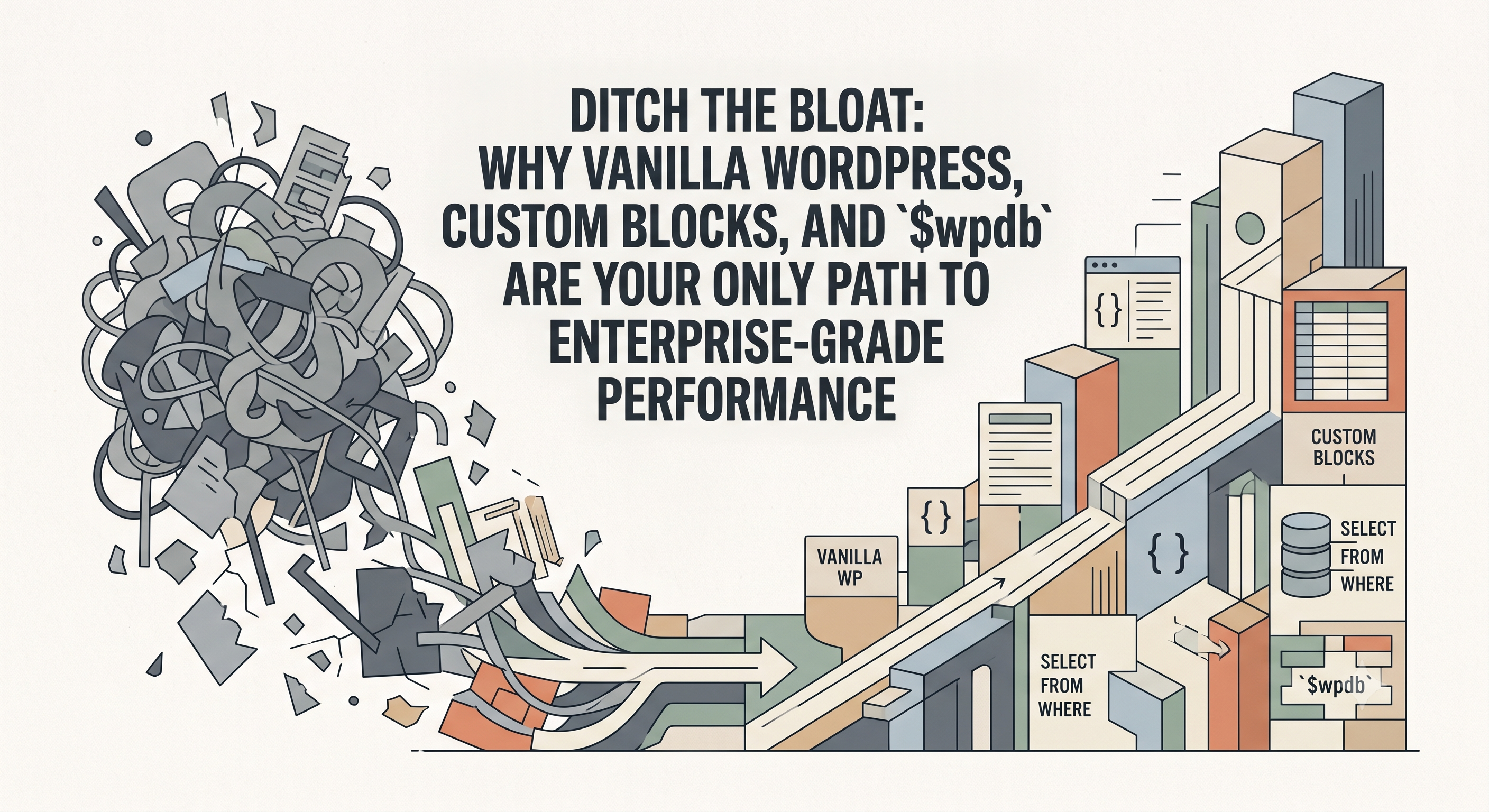
Let's cut through the marketing fluff and get brutally honest about WordPress development. The rise of low-code page builders like Elementor and Divi has created a convenience trap that sacrifices nearly everything truly valuable about a web presence. If you're serious about building anything beyond a rudimentary brochure site that no one will really care about, you are actively sabotaging your project's performance, security, and long-term viability by opting for these drag-and-drop solutions. It's time to stop treating WordPress as a toy and start treating it as the robust application framework it truly is.
Let's talk raw performance, specifically Core Web Vitals. These aren't merely suggestions; they are critical metrics for user experience, search engine ranking, and ultimately, conversion rates. Every extraneous line of JavaScript, every redundant CSS declaration, and every unnecessary DOM node generated by a bloated page builder directly impacts your Largest Contentful Paint, Cumulative Layout Shift, and First Input Delay. When I custom-code a theme, meticulously craft bespoke Gutenberg blocks with vanilla PHP, and implement only the absolutely necessary scripts, I eliminate this inherent cruft. My sites load faster, feel snappier, and Google rewards this efficiency. This isn't just "a little faster"; it's fundamentally lighter, leaner, and exponentially more performant from the ground up, providing a superior user experience that simply cannot be achieved through a drag-and-drop interface.
Now, consider security hardening. Bloated page builders and their accompanying ecosystem of third-party add-ons introduce a vast and entirely unnecessary attack surface. Each additional plugin or theme you install is another potential vulnerability, another entry point for malicious actors looking to exploit known flaws. When you build with a clean, custom theme, carefully selecting only essential plugins, and developing your own custom functionalities with direct PHP and judicious `$wpdb` queries for bespoke data, you drastically reduce this inherent risk. You control the code. You know precisely what's running. This isn't theoretical best practice; this is real-world hardening, essential for protecting sensitive data and maintaining the integrity of your digital assets.
Enterprise-grade projects demand more than just visual appeal. They require modularity, robust version control compatibility, and the inherent ability to grow and adapt without collapsing under their own weight. Page builders generate opaque, often shortcode-laden content that is a complete nightmare to port, upgrade, or integrate seamlessly with sophisticated development workflows like automated testing or continuous deployment pipelines. Try running comprehensive unit tests on an Elementor-built page, or merging complex feature branches from different developers. With custom post types, custom taxonomies, and direct interaction with the database via `$wpdb` for tailored data structures, you construct a truly robust, future-proof architecture. Your content is genuinely decoupled from its presentation, making major redesigns painless and complex feature additions straightforward. This is engineering; the alternative is digital arts and crafts.
The ultimate argument for programmatic control boils down to this: building with custom code – vanilla PHP, thoughtful templating, and purpose-built Gutenberg blocks – grants you absolute, granular control over every single pixel and every piece of functionality. You are no longer fighting against a builder's rigid grid system or its often-limited widget options. You define the structure, the exact logic, and the precise user experience exactly as needed. This leads to cleaner, more semantic HTML, superior accessibility, and a development process that’s empowering rather than frustratingly constrained. It transforms WordPress from a basic content management system into a powerful, highly extensible application framework capable of anything you can imagine.
My advice is direct and unequivocal: if your project truly matters, if performance is paramount, if security is non-negotiable, and if future scalability and maintainability are genuine requirements, then you absolutely must shed the flimsy crutches of low-code page builders. Embrace the unbridled power of vanilla WordPress, dedicate yourself to sculpting your content and functionality with custom blocks, and leverage `$wpdb` for bespoke, optimized data management. It is undeniably a steeper learning curve, requiring actual development skills, but the long-term returns in speed, security, ultimate control, and viability are immeasurable. Stop building fragile sandcastles that crumble with every update; start engineering resilient, high-performance digital foundations.