FlyntWP: My Go-To for Building Lightning-Fast, Bloat-Free WordPress Sites
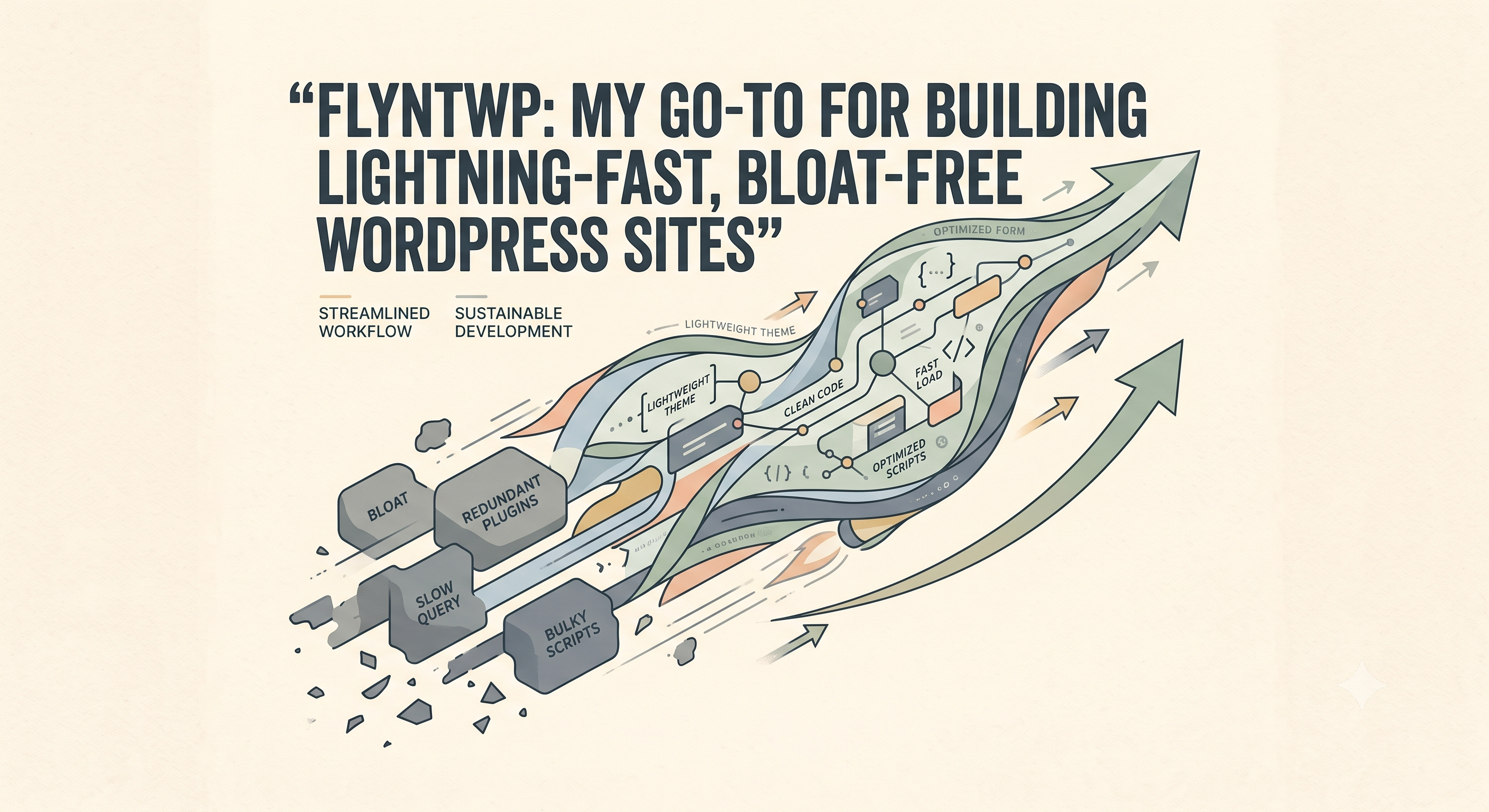
I’ve spent years in the WordPress development trenches, and like many of you, I’ve wrestled with the promise and frustration of low-code page builders. The initial appeal of visual drag-and-drop quickly fades when you’re staring down agonizing load times, mountains of unnecessary CSS and JavaScript, and a DOM structure so convoluted it makes your head spin. My clients need blazing fast sites, and I need a development workflow that doesn't feel like fighting a system designed to slow me down. That's precisely why FlyntWP has become my absolute go-to, representing a refreshing programmatic alternative that genuinely delivers.
FlyntWP isn’t another page builder; it’s a modern development framework for WordPress that empowers developers to build incredibly efficient, high-performance websites. It strips away the bloat and focuses on a clean, component-driven approach. Instead of dragging predefined modules onto a canvas, I'm defining custom, reusable Twig components. This isn't just about aesthetics; it's about control. I write the markup, the styles, and the scripts for each component, ensuring every line of code serves a purpose. This modularity means I can build a library of components – heroes, testimonials, image galleries – that are consistent, easy to update, and perfectly tailored to a project's design system. It’s a developer's dream for maintainability and scalability.
One of FlyntWP’s superpowers lies in its seamless integration with Advanced Custom Fields Pro. This combination is brilliant because it separates content from presentation beautifully. My clients get a familiar, intuitive ACF interface to manage their content, whether it’s text for a headline, an image for a banner, or options for a component's layout. They don’t need to navigate a complex visual editor; they simply fill in fields, and my Twig components handle the rendering. This workflow ensures that while content managers have flexibility, the underlying structure and performance remain firmly in my control. It’s the perfect balance of user-friendliness and developer precision.
And let’s talk about speed – not just website speed, but *my* development speed. FlyntWP leverages Vite for its asset compilation, and if you haven’t experienced Vite, prepare to be amazed. Gone are the days of waiting several seconds, or even minutes, for webpack to rebuild. With Vite, hot module reloading is instantaneous. My CSS changes appear on screen before I even release the key, and JavaScript updates are just as fast. This dramatically accelerates my development cycle, allowing me to iterate quickly and focus on crafting the perfect user experience rather than waiting for tools to catch up. It’s a game-changer for productivity.
The ultimate benefit of this entire approach is undeniably visible in the final product: an unbelievably clean DOM structure and flawless Core Web Vitals. Because I’m building everything with intention, using modular Twig templates and a modern build process, the resulting HTML is lean, semantic, and free of extraneous wrappers and inline styles. This translates directly to outstanding performance metrics. I’m consistently seeing sites built with FlyntWP achieving perfect 100/100 scores across Lighthouse categories and sailing through Core Web Vitals assessments with flying colors. This isn't just good for SEO; it's fundamental to delivering an exceptional user experience on every device.
For developers like me who are tired of fighting slow, bloated systems and aspire to build truly high-performing WordPress websites, FlyntWP is the answer. It’s not about doing less; it’s about doing more efficiently and effectively, giving us the tools to craft bespoke digital experiences that are fast, robust, and a joy to maintain. If you’re looking to reclaim control over your WordPress projects and push performance to its absolute limit, I wholeheartedly recommend exploring FlyntWP. It’s how I build my best work, and it might just be exactly what you’ve been looking for.