Why Your WordPress Site is Slow: The Hidden Cost of All-in-One Themes and Page Builders
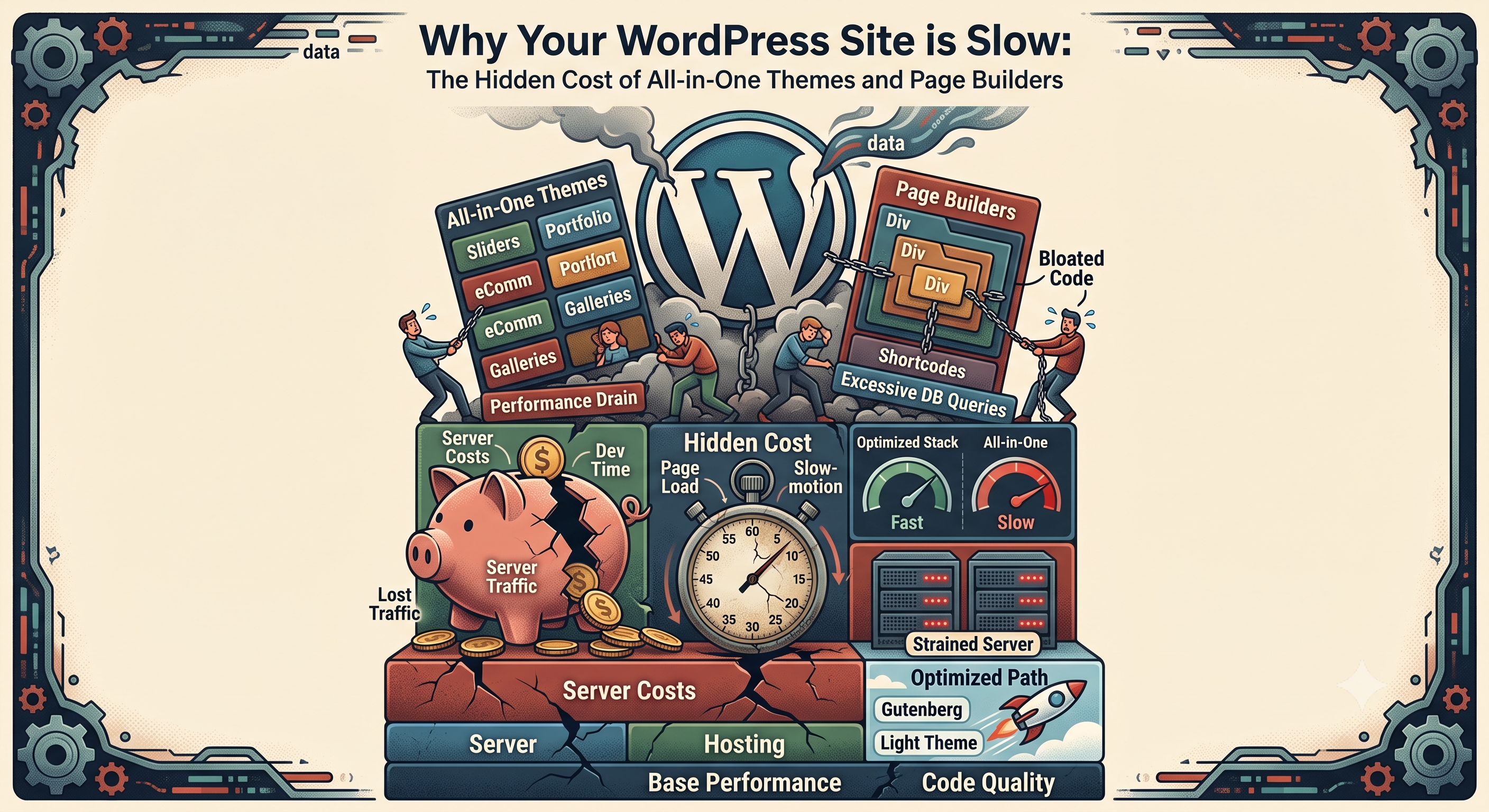
Let’s be honest. Nobody likes a slow website. Not you, not your customers, and definitely not Google. If you’re running a business website on WordPress and it feels like it’s wading through treacle, you’re not alone. I see it all the time, and usually, the culprit isn’t some mysterious cosmic force or even necessarily your cheap hosting (though that can contribute, sure). More often than not, the answer lies in the very tools designed to make building your site "easy": the multi-purpose themes and drag-and-drop page builders.
Remember when you first started looking for a WordPress theme? The promise was intoxicating. "Build any website you can imagine!" "Hundreds of demos!" "No coding required!" It sounds like a dream, doesn't it? You pick a theme, maybe something like Divi, Avada, or The7, because it’s got a million features and a beautiful pre-built demo that almost fits what you want. You think, "Great! I'll just change a few colors, swap out some text, and boom, instant professional website."
And for a while, it feels pretty darn good. You drag a few elements around, add some fancy animations, maybe a parallax scrolling section or a slider with five different transitions. It's empowering, really. You, a non-coder, are designing your own site. Pat yourself on the back!
But here's the kicker: all that "power" and "flexibility" comes at a significant cost. These multi-purpose themes are essentially Swiss Army knives on steroids. They're built to do everything for everyone. Think about it: they need to cater to an e-commerce store, a photography portfolio, a corporate brochure site, a personal blog, a restaurant, and a non-profit. To achieve this, they pack in an incredible amount of code, features, and assets – things you probably won’t ever use.
Imagine buying a car with every single optional extra imaginable: heated and cooled cup holders, a built-in espresso machine, a deployable drone, a retractable mini-golf course. Sounds wild, right? Now imagine that car still has to perform like a sports car. Every single one of those unused features, every line of code, every font icon, every slider animation script, every custom post type for "testimonials" or "portfolios" you didn't activate – it's all still sitting there, waiting to be loaded, even if it's just a tiny bit. This unused baggage is what we call "bloat," and it bogs down your site like nobody's business.
Then we get to the page builders. Oh, page builders. They really did democratize web design, didn't they? Suddenly, anyone could lay out a complex page without touching a line of HTML or CSS. Tools like Elementor, WPBakery (formerly Visual Composer), Beaver Builder, and yes, even Divi's own builder, became incredibly popular for exactly this reason.
The problem, however, is what happens under the hood. When you drag and drop a heading or an image into a page builder, it doesn't just write simple, clean HTML. Instead, it generates a complex series of nested div elements, sometimes wrapped in layers of shortcodes or stored as intricate JSON data in your database. Each module or widget often comes with its own little bundle of CSS and JavaScript files. When you have a page built with dozens of these elements, you end up with a huge amount of markup, styles, and scripts that the browser has to download, parse, and render.
It's like asking your mail carrier to deliver one letter, but instead of handing it over directly, they first have to unpack a nested set of Russian dolls, each containing a tiny piece of the address. It takes way longer! This heavy, often inefficient code structure results in slower page load times, higher "Total Blocking Time," and generally poorer Core Web Vitals scores. Google, ever the stickler for speed, notices this. And when Google notices, your search ranking can suffer.
Let’s not forget the dependency issue. Many page builders essentially "own" your page content. If you decide to deactivate a builder, you're often left with a messy, unreadable "shortcode soup" where your beautiful layout once was. Your content is tied hostage, making it incredibly difficult to migrate or redesign without a massive manual cleanup.
So, what are the real-world costs of this bloat and inefficiency?
- Lost Visitors and Sales: People are impatient. Studies consistently show that most users abandon a website if it doesn't load within a few seconds. If your e-commerce site takes five seconds to load, you're literally watching potential customers click away to a competitor. That’s money directly out of your pocket.
- Damaged SEO: Google prioritizes fast, mobile-friendly sites. Slow sites get penalized in search rankings. If your site isn't performing well on Google's Core Web Vitals, you're losing visibility to potential customers who might never even find you.
- Frustrated Users: Even if they don't bounce immediately, a slow experience is an irritating experience. It chips away at trust and professionalism. It makes your brand seem less reliable, less modern.
- Higher Hosting Bills: A heavier website requires more server resources. You might find yourself needing to upgrade your hosting plan sooner than expected, just to keep your bloated site crawling along.
"But I don't know how to code!" I hear you cry. And that's fair. The allure of these tools is real, and for truly simple brochure sites with minimal functionality, they can still work. But if your business relies on its website for leads, sales, or critical information delivery, you need to think smarter.
Instead of an "all-in-one" theme, consider a lightweight, purpose-built theme that focuses on speed and clean code from the ground up. Themes like GeneratePress, Astra (the lightweight versions), or Kadence are designed to be fast and extensible, giving you a solid foundation without all the extra baggage. Then, if you absolutely need a visual editor for some pages, consider using the native WordPress Block Editor (Gutenberg) – it’s come a long way – or pairing your lightweight theme with a very minimal page builder only where absolutely necessary, and using it judiciously.
The goal isn't to demonize these tools entirely, but to understand their hidden costs. They offer convenience, yes, but often at the expense of performance, maintainability, and ultimately, your bottom line. Before you dive into that "hundreds of demos" theme, ask yourself: Do I really need a flying squirrel animation module, or do I just need my website to load quickly and convert visitors into customers? Because in the age of instant gratification, speed isn't just a nice-to-have; it's a non-negotiable business asset.